Let me be straight with you. When a phone costs under $200 and carries the Samsung name, your brain does two things at once — it gets excited and suspicious at the same time. I’ve been there. The Samsung Galaxy A13 landed on my desk a few weeks back, and I did what I always do: I used it as my daily driver, put it through everything, and waited to see what broke first. Spoiler: less broke than I expected.
If you’re hunting for an honest Samsung A13 review that skips the spec-sheet recitation and tells you what it’s actually like to live with this phone — you’re in the right place. Grab a coffee. This is going to be a real conversation.
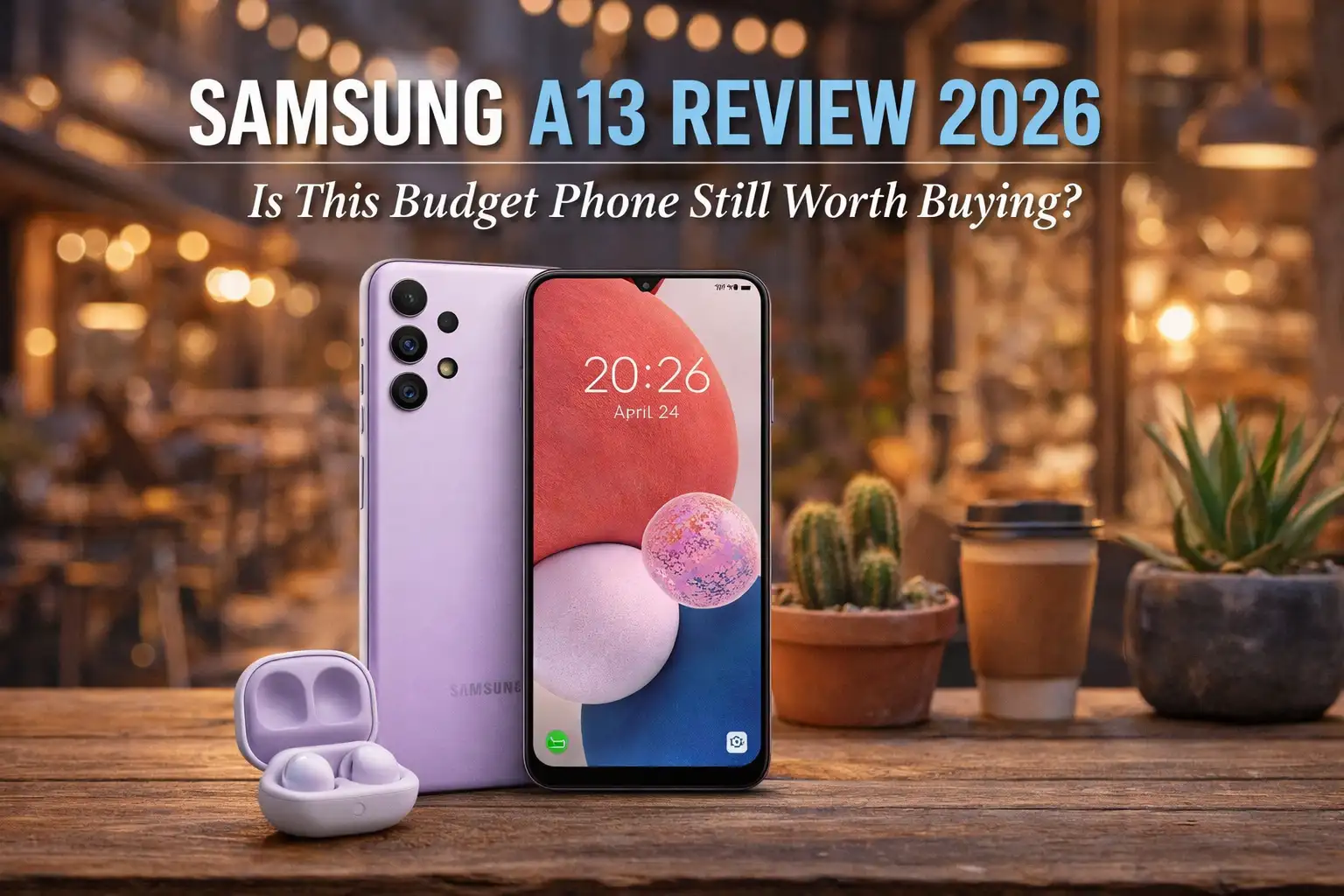
Samsung Galaxy A13 Overview: What Kind of Phone Is This, Really?
The Samsung Galaxy A13 sits firmly in the budget-to-mid-range category — a segment that’s gotten surprisingly competitive over the past few years. Samsung designed this phone for people who want a reliable, recognizable brand without paying flagship prices. Think of it as the sensible family car of smartphones: not exciting, not flashy, but dependable and surprisingly well-equipped for what it costs.
It launched with Android 12 and One UI Core 4.1, with Samsung committing to security updates through 2026. The base configuration offers 4GB of RAM with 64GB of internal storage, expandable via microSD up to 1TB — a detail that budget phone buyers genuinely appreciate when their camera roll starts getting out of control.
On paper, the A13 checks every box you’d need for everyday use. The question is whether it delivers on those specs in practice. That’s where most budget phones quietly disappoint, and that’s exactly what I spent weeks finding out.
Samsung A13 Design and Build Quality: Does It Feel Cheap?
Here’s something I didn’t expect: the A13 doesn’t feel like a throwaway phone. The plastic back has a matte finish that resists fingerprints well — better than most glass-backed phones at twice the price. It’s not going to win design awards, but it’s clean, professional, and doesn’t scream “budget” the way some competitors do.
The 6.6-inch display takes up most of the front face, with a punch-hole camera cutout centered at the top. The bezels are visible but not offensive. At 195 grams, it has a solid feel in hand — substantial without being heavy. I handed it to my neighbor’s teenager who immediately commented it looked “like a real Samsung,” which I think was meant as a compliment.
The side-mounted fingerprint sensor is fast and accurate — I registered it incorrectly twice before I gave it a proper scan, and after that it unlocked consistently on the first press. The USB-C port at the bottom and the 3.5mm headphone jack (yes, it’s still here) round out a practical physical layout.
Samsung A13 Display Quality: Good Enough for Daily Use?
The 6.6-inch PLS LCD panel runs at 1080 x 2408 resolution — that’s Full HD+, which delivers crisp text and clean images for anything you’d realistically do on a budget phone. Streaming, social media, reading, light gaming — it handles all of it without visible pixelation.
The 60Hz refresh rate is where the A13 shows its budget DNA most clearly. Coming from any phone with 90Hz or 120Hz, scrolling feels slightly less fluid. It’s not a dealbreaker, but it’s noticeable. Outdoors in bright sunlight, brightness maxes out at around 800 nits — adequate but not exceptional. I found myself squinting occasionally at midday.
For the target market — someone upgrading from a 3 or 4-year-old mid-ranger or switching from a basic carrier phone — the display will feel like a genuine upgrade. For anyone coming from a modern flagship, the step down will register.
Samsung A13 Performance Review: Can It Handle Everyday Tasks?
The A13 runs on the Exynos 850 chipset — an octa-core processor clocked at 2.0GHz. This is where the phone asks the most of your patience. Day-to-day tasks like texting, browsing, email, YouTube, and social media run smoothly enough. App load times are reasonable. Phone calls and video calls over WhatsApp or FaceTime worked without hiccups throughout my testing.
Where the Exynos 850 shows its limits is in multitasking. Keep five or six apps open simultaneously and you’ll notice the system pausing slightly when switching between them. It’s not dramatic — more like a half-second hesitation than a full stutter — but it’s there, and it accumulates over a day of heavy use.
Gaming is possible with lighter titles — Candy Crush, casual card games, basic puzzle apps run fine. Call of Duty Mobile and similar graphically demanding games work but require setting graphics to low or medium to avoid choppy performance. This isn’t a gaming phone, and Samsung never marketed it as one. For the primary use case — being a reliable daily communication device — the performance is genuinely adequate.
Samsung A13 RAM and Storage: Is 4GB Enough in 2026?
This is a fair question to ask. 4GB of RAM was considered middle-of-the-road a few years ago; in 2026, most mid-range devices ship with 6GB or 8GB as standard. The A13’s 4GB shows in multitasking situations — background apps get cleared from memory faster than you’d like, meaning you’ll sometimes return to an app and find it has reloaded from scratch.
Samsung does offer a 6GB/128GB variant in some markets, which addresses this somewhat. If that option is available where you’re shopping, it’s worth the modest price difference. The microSD expandability also helps — 64GB internal storage fills up quickly with photos, apps, and offline content, so having a slot for a 128GB or 256GB card is practically essential.
Samsung A13 Camera Review: Four Lenses, Real-World Results
The camera setup is one of the A13’s headline features — a quad-camera system led by a 50MP main sensor. That’s a genuinely impressive spec for the price point, and in good lighting, the results back it up. Outdoor daylight shots are sharp, colors are natural without Samsung’s usual tendency to oversaturate, and detail is strong enough that you’d comfortably print a 4×6 from most shots.
The 5MP ultrawide lens and 2MP macro and depth sensors are present mostly to pad the spec sheet. The ultrawide is usable but loses sharpness at the edges. The 2MP sensors aren’t doing much meaningful work — I tested both extensively and found myself defaulting back to the main lens for almost everything.
Low light performance is where the A13 gives back some of its daylight goodwill. Indoor shots in moderate lighting come out acceptably — grainy but usable. In dim conditions, images get muddy and detail falls apart. There’s a dedicated Night Mode that helps modestly, but it requires a steady hand and a patient subject. Nothing you’d post professionally, but fine for documentation and memory-keeping.
Samsung A13 Front Camera: Are Selfies and Video Calls Decent?
The 8MP front camera handles selfies and video calls competently. Face detail is soft rather than sharp — Samsung’s processing smooths skin a touch more than I prefer — but for WhatsApp calls, Zoom meetings, and casual selfies, it’s entirely adequate. In good window light, front camera shots are genuinely flattering. Under artificial indoor lighting, results get a bit flat. Video records at 1080p, which is all most people need for calls and basic social content.
Samsung A13 Battery Life: The Phone’s Biggest Strength
If there’s one area where the Samsung A13 genuinely punches above its weight, it’s battery life. The 5,000mAh battery is a standout feature, and in real use it delivers. I consistently got through a full day of moderate-to-heavy use — emails, social media, two hours of video streaming, navigation for thirty minutes, and a handful of calls — and still had 25 to 35 percent battery left at bedtime.
Light users will comfortably hit two days between charges. The energy-efficient Exynos 850 and the LCD panel (which consumes less power than AMOLED) work together to stretch that 5,000mAh further than similar capacity batteries in more power-hungry phones.
The included 15W charger is functional but not fast by 2026 standards. A full charge from empty takes around two hours. There’s no wireless charging — expected at this price point. What you do get is a charger in the box, which is increasingly rare even in premium devices.
Samsung A13 Software Experience: One UI Core and Long-Term Support
The A13 ships with One UI Core — a lighter version of Samsung’s full One UI interface. It’s clean, well-organized, and familiar to anyone who’s used a Samsung device in the past few years. The learning curve is minimal.
Samsung pre-installs a modest amount of bloatware — a handful of Samsung apps, some carrier additions depending on where you purchase — but it’s not excessive, and most can be disabled if not uninstalled. The interface responds well in standard use, though you’ll occasionally notice the animation smoothness is tuned conservatively to preserve performance on the modest hardware.
Samsung’s commitment to four years of security updates for A-series devices is a genuine value-add that often goes unmentioned in reviews. At this price point, extended software support means the A13 should remain secure and functional well beyond what many budget competitors offer.
Samsung A13 vs Competitors: How Does It Stack Up in 2026?
The A13’s main competition comes from the Motorola Moto G series, the Xiaomi Redmi Note lineup, and the Realme C-series. Each has its own tradeoffs.
Against the Moto G Pure and Moto G Play, the A13 wins on camera quality and software support length. Against Xiaomi Redmi Note 12, the A13 loses on processor speed and display refresh rate but wins on brand recognition, after-sales service availability, and — depending on your region — price. Against Realme budget offerings, the A13 trades raw performance for Samsung’s software polish and reliability track record.
The honest summary: the A13 isn’t the fastest or most feature-packed phone in its class. It is arguably the most balanced and the most risk-free purchase. Samsung’s ecosystem, service network, and brand reliability carry meaningful weight for buyers who want confidence more than specs.
Who Should Buy the Samsung A13 in 2026?
The A13 makes most sense for a specific kind of buyer. If you’re a first smartphone buyer or helping a parent or grandparent choose a reliable device — this is a genuinely excellent recommendation. The familiar Samsung interface, the long battery life, the solid build, and the accessible price combine into something that’s hard to fault for the use case.
It also works well as a secondary phone, a travel device, or a work handset for employees who need reliable communication without corporate spend on premium hardware. If you want to game competitively, shoot professional-quality video, or run demanding productivity software simultaneously — look elsewhere. But if your needs are communicating, browsing, streaming, and capturing memories — the A13 covers all of that without complaint.
Samsung A13 Pros and Cons: The Honest Summary
- ✅ Excellent battery life — genuinely lasts all day and then some
- ✅ Solid main camera for the price in good lighting
- ✅ MicroSD expansion up to 1TB
- ✅ 3.5mm headphone jack present
- ✅ Clean Samsung software with long security update support
- ✅ Dependable brand with wide service network
- ✅ Charger included in box
- ❌ 60Hz display — scrolling feels less smooth than modern competitors
- ❌ Exynos 850 shows strain with heavy multitasking
- ❌ Low-light camera performance is mediocre
- ❌ 15W charging is slow by 2026 standards
- ❌ 4GB RAM base model feels limited for future-proofing
Final Verdict: Is the Samsung A13 Worth It in 2026?
After weeks of daily use, the Samsung A13 earned my cautious but genuine recommendation — with one important asterisk. At its original launch price of under $200, it was excellent value. In 2026, you may find it discounted further, which only strengthens the case.
What you’re paying for isn’t bleeding-edge performance. You’re paying for Samsung’s reliability, its software commitment, a camera that does its primary job well, and a battery that won’t leave you stranded. For the right buyer — someone who needs a dependable everyday phone without drama — those qualities are worth every dollar.
Score: 7.5 / 10 — A reliable, well-rounded budget phone that does the basics very well and the extras well enough. Not exciting, but trustworthy — and sometimes that’s exactly what you need.
If you’re considering the A13 or have already made the switch — drop a comment below. I read every one, and there’s always something useful in hearing how a phone performs in someone else’s hands.
Samsung A13 — Frequently Asked Questions
Is the Samsung A13 still a good phone to buy in 2026?
Yes, particularly at its current discounted price points. The Samsung A13 covers everyday smartphone needs — calling, messaging, browsing, streaming, and basic photography — reliably and without drama. For budget buyers or those buying a phone as a gift for an older family member, it remains a safe, well-supported choice in 2026.
How long will Samsung support the A13 with security updates?
Samsung committed to four years of security updates for A-series devices. The A13 launched in 2022, meaning security patch support runs through approximately 2026. This is a meaningful advantage over many budget competitors that offer only one or two years of updates.
Does the Samsung A13 support 5G connectivity?
The standard Samsung Galaxy A13 is a 4G LTE device. Samsung released a separate Samsung Galaxy A13 5G model with different hardware specifications — a different chipset and slightly different camera configuration. If 5G connectivity matters for your network, confirm which variant you’re purchasing, as the naming is confusingly similar between the two.
What is the Samsung A13 battery life like in real-world use?
The 5,000mAh battery is the A13’s strongest feature in daily use. Moderate users consistently get through a full day with battery to spare. Light users regularly achieve two full days between charges. The 15W wired charging is functional but slow — a full charge from zero takes approximately two hours.
Is the Samsung A13 camera good enough for everyday photography?
In daylight and good indoor lighting, the 50MP main camera produces sharp, natural-looking photos that are more than adequate for social media, family memories, and everyday documentation. Low-light performance is the main weakness — images become grainy and soft in dim conditions. The secondary 2MP macro and depth sensors add limited practical value. For casual photography at the price point, the main camera delivers solid results.
How does the Samsung A13 compare to the Samsung A14?
The Samsung Galaxy A14 is the direct successor and offers meaningful improvements — a faster processor (Exynos 1330 or Dimensity 700 depending on variant), a 90Hz display option, and improved RAM configurations. If the A14 is available at a comparable or modestly higher price, it’s the better long-term investment. If the A13 is significantly cheaper in your market, its core strengths — battery life, build quality, and camera — still make it a reasonable choice.
Does the Samsung A13 have a headphone jack and expandable storage?
Yes to both — and this deserves emphasis because both features are disappearing from modern smartphones at every price tier. The A13 includes a 3.5mm headphone jack and a dedicated microSD slot supporting cards up to 1TB. For users who rely on wired headphones or need affordable extra storage, these are genuinely practical advantages over competing devices.
About the Author

David Dion — Quebec, Canada
Web entrepreneur, blogger, and product reviewer with over a decade of experience testing consumer tech, health products, and digital tools. David has reviewed hundreds of products across multiple categories with a single editorial standard: if he wouldn’t recommend it to a friend, he doesn’t recommend it here. Follow his latest reviews at productxreviews.com.